Wednesday, January 28, 2009

Vale The Foundry

One of the first label to support Ampersand when I first went solo was The Foundry. Label boss M Bentley created much of the early music (as eM, part of Apiary, Mollusk and himself) and also printed a fine line of chapbooks. Over the years the label expanded both its roster and its reach - and for a time was releasing material in conjunction with Hypnos. Satisfying both auditory and visual systems, The Foundry was a label you could rely on to give pleasure. 

Things had been quiet at the website for a while, and on a visit today found the inevitable - a goodbye from Michael.

All I can say is that another great label has gone, and that if you can find any of the releases, including on the Archipelago sublabel, go for it.

Thanks for it all Michael - it will be fondly remembered.


Thursday, January 22, 2009

Seeded Plain: Land tract

The latest (and first of a new batch) from Bryan Day, this time as Seeded Plain, with jay kreimer, released on featherspines. They are both credited with objects and time on this release Land Tract. 

Many years ago I reviewed an album by Anna Planeta recorded in an abandoned school, which this reminds me of (something of a gratuitous reference which few people will have heard - but it was on the lovely named label Betley welcomes careful drivers). 

It sounds like a couple of guys have gone in to a room full of various bits of pieces and have spent a jolly time twanging on metal, singing a bit, banging around - contact mikes and perhaps a bit of processing - to create 70 minutes of formless noises, with odd titles (arise-d or berel-ed - but I note their label doesn't worry with the suffices). Which isn't necessarily a bad thing, but I am not sure it is something you want to listen to, although it is quite diverting as a background noise as the twangs wobble, metal things are rattled and banged, rattles and squeaks, density builds and diminishes, voices/vocals appear in the mix (and some coughing), whirring sounds, humms pass. All in all a noisey experience, which makes quite a diverting sort of background soundscape  as it weaves in and out of the foreground, making you wonder what is being played with at various points. Impossible to describe in any detail, I have played it through 3 times already now and continue to be diverted by it.

Tuesday, January 20, 2009

2009

I am back from a break in which my classical fascination has been satisfied by The rest is noise and a welter of cheap bigpond downloads, including: multiple disk sets of Stravinsky orchestral, Webern (the complete Boulez), Dvorjak string quartets, Nielsen symphonies, Miavokvsky complete orchestral, Bernstein conducts Bernstein, Lutoslawski, single disgs of Berg and Dutilleux, and just to spice it up, a couple of Miles Davis albums (each side a single track). 

While still digesting this cornucopia I am also back in the reviewing seat, so I hope to get a few reviews up soon (though work in the new year is always busy, plus we are moving). Back soon

Tuesday, December 23, 2008

2008 - a review

Hi - something of a traditional last post of the year - not a best of but a few things I have come across and been up to.

First, much of my recent listening has been to podcasts, and I have found a few, available via iTunes, which have filled my time or look like they will in the future
Guardian music weekly - a half hour or so of banter, a couple of interviews, a lost pleasures section (to be named) and a singles review. The music comes in snatches (a minute or so of the 3 reviewed singles, a minimontage of other releases, bits in the interviews) but it is a very enjoyable show.
WNYC soundcheck - about an hour a day of comment, live performances and interviews. A very wide remit from classical through hiphop to latin. Not always right up my alley, but nicely varied to give some good listening.
NPR All songs considered - like an expanded Soundcheck: mainly because it has an hour a week to go into depth. Have only recently found it, but their The Beatles 40th anniversary special was stronger than Soundchecks, for example, and they devoted 2 hours to 1000 recordings to hear... They also feature extensive music samples.
NPR Live concerts: now this is a find, concerts by Bjork, Nick Lowe, Radiohead, Bon Iver, Tom Waits, Fleet Foxes and many many more. Excellent.

I've been listening to a lot of classical music lately, partly due to the generosity of Bigpond here in Australia. It now has DRM-free MP3s and a generous pricing of classical multidisk sets: they charge standard album prices irrespective of the number of disks. Which can be a minor problem as, mentioned before, they don't include the disk number in their ID3 tags. Some recent pleasures are Bernstein's The Americans set (all 20th century), some Hindemith and a full set of Shostakovich symphonies. At the moment they have a 50% discount on gift vouchers, which means a set costs $8aus. I am looking forward to a voucher for Xmas and have planned to download the full symphonies of Nielsen and Miaskovsky, more Hindemith, some Lutoslawski, complete Dvorak quartets and maybe even some single albums!

Helping me decide is another present - Alex Ross's The rest is noise - an award winning survey of 2oth century classical music.

Anyway, have a great break and the blog will be back reviewing in the new year.

Thursday, December 18, 2008

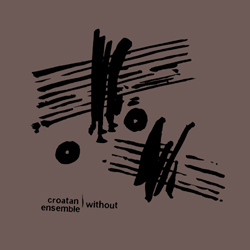
Croatan ensemble - Without

The final disk in this trilogy of Eh? releases is number 44 - Croatan Ensemble's Without. They are bill k and jason p on strings, laptop, electronics, mics, pedals, synths, pipe instruments and generators.This is another longer album (60+) compiled from various improvised sessions. The album is tripartite, and the structure reflects the music.

The world ending in a festival of light and Concentration camps open the disk. These are dense combinations of tones, loops, hissing, buzzing with hidden components that reminded me to some extent of Fripp&Eno in structure and the guitar in Concentration. The World is full bodied, assaultive and slowly changing, while Concentration moves through more changes, pulsing and shimmering guitar dropping to long tones before rebuilding. At this stage I was also reminded of Eno's comments about improvisation also being about knowing when not to play.
But then came the three parts of The ideology of control. Here there is a sparser production with more control of elements moving in and out. Domestication has a bit of a beat, pulsing, encroaching deep tones with some accentuations but more minimal, distant metal tones somewhat edgy. It flows straight into Normalisation with rhythmic tapping, scrapes, gentle guitar and an overall brooding mood. Slides into Surveillance, a slow burning buzzy building dark ambient finale.
Defacement ends the album, another shift, again more minimal - opening with insistent pulses, voices enter, building to a density similar to the opening tracks, and ending with a siren.
Over the length of the whole album there is a good balance between the dense static ambience and the more subtler varied material - which makes the full listening experience an exciting journey. I think that this has been a good year for Eh? as they develop a diverse and diverting roster: satisfyingly unpredictable.

Wednesday, November 26, 2008

666 notes to hear before you go deaf

Hot on the heels of 1000 recordings to hear before you die, Toby Cresswell's 1001 songs: The Great Songs of All Time and the Artists, Stories and Secrets Behind Them, Pitchfork's 500 greatest songs and Robert Dimery's 1001 albums you must hear before you die comes 666 notes to hear before you go deaf from Anita McSusic. 

Working from a severely limited sound palette - after all there are only so many notes available, even when you take the sharps and flats or just look at the black and white keys of the piano - McSusic finds an artistic diversity within this constraint. She has, for example, identified an A flat in The Rolling Stones Symphony for the Devil which is markedly different to the A flat in the third movement of Beethoven's fifth symphony. Or, taking another example, a shifting B in the middle of a Kronos quartet glissando and one in Nine Inch Nail's Ghost IV.

For each of the notes she has identified, McSusic weaves a fascinating text, exploring how the composer reached that particular note and why she has selected it: a C sharp in Brian Eno's Discreet Music, appearing briefly at 15:32 apparently is a response to a draft caused when Robert Fripp entered the studio while Eno was creating the piece, and the tape slowed marginally. Eno discusses how he debated whether to rerecord the whole section or let that note pass. As it was one of a number of Cs within the work, and following pulling out an Oblique Strategy card that read 'Do not pass: go', the note remained. As you listen to this note in the book, the pitch has a subtle tenderness that is not present in some of the other C sharps.

When talking about historical notes, where there is no composer to discuss the material with, interviews with current performers explore how they respond to the notes McSusic has identified, and how they decide to play them. Intriguing twists emerge from this - for example the different ways that the Emerson and the Duke quartets play an F flat in Shostakovitch's 7th string quartet.

Each note has been identified in a particular recording which is available on CD - this makes it possible to find all 666 notes precisely - they are often surrounded by similar notes and identifying the one in question can be difficult. There is some discussion of putting all 666 notes onto a single CD, but that would detract from the thrill of the hunt. And the notes need to be heard in their context.

The book is organised around a sorting principle based on the composers first name, the not as written in German and the difference in the year of recording and composition. Luckily both the table of contents and the index are comprehensive and assist in navigating through the book. Though ones like this are meant for dipping.

Yes - as with all lists there will be notes that you wonder why they aren't there, and countries who are under represented (very little from Australia for example, though the opening note of Rolf Harris' Sun arise gets a guernsey). But if you want to explore notes written by people as diverse as the Sex Pistols and Stravinsky, Steve Reich to Stevie Wright, Mellencamp to Miaskovsky look out for this book, and take part in the on-line debate about those missing notes on the official website..