Things are quiet here at the moment - though not workwise.
So a couple of Roden related things.
My podcast listening has broadened since hearing Marco Arment on his new podcast app & I know listen to the accidental tech podcast, the new disruptors, the talk show. Anyway, the new disruptors got me to 99% invisible an interesting design based show, and I found this in their archive - a program on bubble houses. Now most of you should know Steve Roden lives in a bubble house (the last in the US, which I didn't know) and this program is about them & he's on it. The show page has some great photos. (and to remind you, airform was the construction method).
And then, on airform archives is a link to this kickstarter project to releaunch a label (dragon's eye). Steve has put up some great stuff for big donor's but also has a cd in the release schedule (a year away - but so what!). 6 days to go, the limit has been met, so you will get your cds.

From Vivisect to ambience to the newsletter to the website to the blog and back. Returning from a period of stasis (appropriately for an ambient blog) we are re-energised to provide more solipsism. There will be some reviews, some comments and a new trip-down-memorylane called Things In My Room which combines it all. Thanks for listening
Monday, October 28, 2013

Sunday, October 6, 2013
Pocket Cast
One of the first apps I bought for my iPhone 3 was pocket weather (aka pkt weather and now weather Australia). I found the onboard app inaccurate and limited in detail. Pocket uses Bureau of Meteorology data which is the best available. The app also includes a wealth of detail - 7 day forecasts (obviously), radar, 2 day temperature forecast graphs with actual(predicted) & feels like lines, rain time and amount, tides... As the Bureau's data has improved so has the app - it now has quite fine localization. It is one of my most used apps.
Move forward & I hear Marco who created Instapaper (another long time very used app) is writing a podcast app. I have used iTunes & the podcast app most of the time (there was a period I used another app but it fell by the wayside). I was generally happy but some things with in interface always annoyed me (the placement of the store button for instance). Anyway I thought I'd see what the competition was.
A few searches narrowed the field to the main players. One was getting a lot of praise for it iOS 7 implementation. Pocket Cast by Shift Jelly- it took me a little while to see the connection and a combination of the reviews, my experience with their weather & the fact they are Australian decided me on giving them a go.
And I am very pleased
Yes - it is a very nice implementation of the design aesthetic. Clean & effective, overall easy to pick up & work with. There are 2 main screens.
Podcast view- all your subscriptions in an icon grid. 3x4 on a 4s. You can move the tiles around if you want to re-order them. A + 'button' takes you to the search area - with featured, search, networks, category, chart options.
Back at the grid tapping on an icon brings up the program information - a list of unplayed and played files, indicating if they have been downloaded their length, and if they haven't, the file size. Tapping on a program brings up a window about it with content details and actions (download, delete, mark as played/unplayed, star, queue, add to playlist (which are way to create) etc).
 |
| Podcast view - note now playing |
 |
| Episode view |
 |
| episode info |
 |
| Menu screen |
PC uses notifications well to indicate when new episodes of subscribed podcasts are available. And my filter new/undownloaded Is set so that I also have a list available - and I can go there to download or mark as played (you can't delete an undownloaded episode, so the list of unplayed will show all available ones which annoyed me at first but I am getting used to it (rather than the past players where previous episodes were hidden by default or could be deleted from the list)

 |
| filter options |
Play - as the screen shots show, there is a floating playback control, and the circle around the play/pause button indicates time passing. Touch this and you get the full screen player - with all the visuals and controls you could want. << and >> skip a predetermined time set from the setup menu. Information, playlist controls are up the top right. Rather than having space dedicated to a volume slider, that is accessed by the speaker menu: and most of us probably use earphone volume controls, the buttons or some external control anyway.
Speed of replay has a slider also, and can do increments up to 3x.
 |
| Play screen |
Sync - You can set up an account to co-ordinate your subscriptions and playing position. It is syncing and saving where all non-Apple apps seem to suffer for me. All the podcasts on the list are 'mine', there are others that I give Carol a copy of. Now we have an expensive internet contract - rural wireless broadband & I would rather not download them twice. With the Apple app & iTunes sync the files are available to copy. I think this is a fairly specific requirement so won't hold it against them - there probably aren't any that do it.
This is a universal app, so no need to pay for a separate app, and is also available in an android version
In conclusion - a very nice podcast app, does everything most people could want very nicely. You can suffer a free app or pay a little bit & get something good.
The website is here; buy from your favourite Apple or Android shops!
(Drafted on write for iPhone)


Thursday, October 3, 2013
Nels Cline & Elliot Sharp: Open The Door
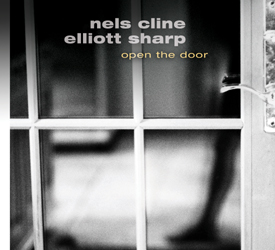
The name Elliot Sharp was familiar, though not Cline. Anyway, two guitarists. This release had a long gestation. Four tracks come from sessions in 1999 while the fifth track (Pietraviva) is live from 2007.
I put on this album with some trepidation, uncertain about the 2 guitar approach. But it is a lovely album. The Cline and Sharp have approached their interplay with a combination of musical artistry, serious skill, joyful interaction and a sense of play and adventure.
Yes at times it is atonal or dense or oblique at times, but the two instrumnets complement each other brilliantly, one providing a base while the other may be searching the acoustic space. And both guitars are acoustic, adding to the atmosphere. There are elements of Spanish, blues, modernism and bluegrass emerging through the pieces; the lead and rhythm change; there is space and then density.
Obviously, if you don't like or want to try acoustic loose guitar, avoid this album. But if you are interested in an exploration which thrills, entrances and entertains give this a go.
Sunday, September 29, 2013
The Kills - Richard House (updated as I finish volumes) FINAL UPDATE
I like to think of my readers as intelligent, literary, interested in music and the new, broad of mind and interested in saving money. So this one's for you.

On the long list this year for the Booker prize is The Kills by Richard House. It's not on the short list, but the long list gave it some prominence and it garnered some excellent reviews and comment.
It consists of four separate but interconnected novels. The first Satler is a page turning thriller that starts in Iraq & traverses turkey to Malta and Europe, with random encounters, deaths and mystery. Thoroughly enjoyed its complex incompleteness (after all, it's only the first part, but I am not expecting answers to everything by the end - it's that sort of book), but satisfying. The next The Massive takes the situation from the opening of book 1 (a dump in the desert run by contractors) and expands on it backwards and possibly forward (it does). Characters recur and get filled out with personalities and histories.
I haven't read The Kill (3) & The Hit (4) yet, but know 3 concerns a novel that gives the novel its name & has been being read at various times - and I expect some of the characters will pop up. The Hit then returns to Satler apparently and muddies that story. I think that there will be a lot of fun following the links, puzzling over uncertainties and just enjoy a well written book..
So why here?
2 things. The novel in electronic form contains links or embedded content (which, beware, make the files bigger) of films, phone calls, maps. So far I haven't found them intrinsic, but they are an indication if where fiction could go.
But to my money conscious literary readers, if you go here (paywithtweet) you can get volume 1 as a free download if you sell your soul and send a tweet. My twitter following is pitiful so there won't be too many people bothered by the spam! Alternatively, each volume is quite cheap from amazon or apple (au$2.99 each from iTunes) which makes up to a good value equivalent 1000 page book.
As I said, really enjoyed volume 1, 2 is great too but going a different direction, more personal story/ies. Will report back.
Quick note: do not read the brief blurb for the fourth novel before reading it. It clarifies the role of a main protagonist, while a pleasure of the first third to a half is wondering where these characters fit and their roles.
Ok - have finished volume 2 and thoroughly enjoyed it. It completes some of the picture seen in volume 1 explaining the blast, raises questions about where Satler is, and the question of Guezzler broadens from merely his puppetmaster-like role, but also his identity at the end of 2. The book discussed in 1 was a film in 2 and will be volume 3. So 4 will have to wait to supply more answers.
Quick note: do not read the brief blurb for the fourth novel before reading it. It clarifies the role of a main protagonist, while a pleasure of the first third to a half is wondering where these characters fit and their roles.
Ok - have finished volume 2 and thoroughly enjoyed it. It completes some of the picture seen in volume 1 explaining the blast, raises questions about where Satler is, and the question of Guezzler broadens from merely his puppetmaster-like role, but also his identity at the end of 2. The book discussed in 1 was a film in 2 and will be volume 3. So 4 will have to wait to supply more answers.
Volume 3: an interesting murder mystery where we don't really know who was murdered. It is based on the book & film mentioned in 1&2. Lovely writing, amazing sense of dread built, but asks questions and answers few. About its content and action - but also what is it doing here! At this stage I can't see the link to the other volumes other than as mentioned in them.
I am getting through this quickly - don't often read through a novel as big as this so precipitously. What is glorious is the questions it leaves unanswered!
And now finsihed. The final volume continued from the end of the first. Introduced some new characters, revisited some old. A very clever use of the book by one character. Some questions answered, not all ends tied. But another very good read.
Overall well worth the time and money - and enjoyable and thought provoking read. He is great at creating a sense of dread. DON'T READ THE BLURB FOR THE HIT BEFORE STARTING - IT IS A TERRIBLE SPOILER.
Recurring aspects: unidentified deaths, unknown deaths. Misidenticication, misunderstanding. Uncertainty as to the fate of characters. Coincidences.
Well managed development of our understanding.
I was wondering about the placement of The Kill as the third volume. It doesn't directly link in terms of characters, however what I think is that it is largely there as a metafictional game - to remind us that everything between the covers is a novel; and that seeking answers for all the uncertainties in the 3 other books is like expecting the third book to be true - it is all lies. Themes/strands of the overall novel are exlored in this one. But that all 4 novels refelect life in terms of its undertainty and openness.
And a final note on the embedded material - it is interesting and adds a little detail but is not essential. The final film, which explains how Mr Wolf & his brother got the original original novel for their exploits in part 3 was filmed at Halong Bay (which I visited recently) and coincidentaly I have changed my phone wallpaper to a panorama of the bay as it works very nicely with iOS 7 - but coincidence or what!!!!
FINAL FINAL NOTE a couple of days later: This novel, set of novels has stuck with me - thinking about the plot, the fascinating intertwining and the simple pleasure. Well written, well plotted and fascinating - it is totally absorbing as a straight novel, but retrospectively mesmerising in its structure. I read all 1000+ paper pages on my iPhone & enjoyed every minute. Get the free first volume & you will want to buy the other 3 - money well specnt.
I am getting through this quickly - don't often read through a novel as big as this so precipitously. What is glorious is the questions it leaves unanswered!
And now finsihed. The final volume continued from the end of the first. Introduced some new characters, revisited some old. A very clever use of the book by one character. Some questions answered, not all ends tied. But another very good read.
Overall well worth the time and money - and enjoyable and thought provoking read. He is great at creating a sense of dread. DON'T READ THE BLURB FOR THE HIT BEFORE STARTING - IT IS A TERRIBLE SPOILER.
Recurring aspects: unidentified deaths, unknown deaths. Misidenticication, misunderstanding. Uncertainty as to the fate of characters. Coincidences.
Well managed development of our understanding.
I was wondering about the placement of The Kill as the third volume. It doesn't directly link in terms of characters, however what I think is that it is largely there as a metafictional game - to remind us that everything between the covers is a novel; and that seeking answers for all the uncertainties in the 3 other books is like expecting the third book to be true - it is all lies. Themes/strands of the overall novel are exlored in this one. But that all 4 novels refelect life in terms of its undertainty and openness.
And a final note on the embedded material - it is interesting and adds a little detail but is not essential. The final film, which explains how Mr Wolf & his brother got the original original novel for their exploits in part 3 was filmed at Halong Bay (which I visited recently) and coincidentaly I have changed my phone wallpaper to a panorama of the bay as it works very nicely with iOS 7 - but coincidence or what!!!!
FINAL FINAL NOTE a couple of days later: This novel, set of novels has stuck with me - thinking about the plot, the fascinating intertwining and the simple pleasure. Well written, well plotted and fascinating - it is totally absorbing as a straight novel, but retrospectively mesmerising in its structure. I read all 1000+ paper pages on my iPhone & enjoyed every minute. Get the free first volume & you will want to buy the other 3 - money well specnt.
A side note about reviewing: when deciding whether to buy these I looked at online reviews. In the Telegraph they say that The Massive We know at the start that these men will die of horrific cancers within a few months of each other. Yet it is very obvious, as the first chapter goes through the deaths (yes) that there are a variety of causes (including suicide) and that the first reported (the last actual) is Santo which makes distinct reference to 36 years of psoriasis and the next starts "before Luis by 18 years came Clark" - makes you wonder how much they read if they get lost in the first chapter
Tuesday, September 24, 2013
TIMR 23 : tom phillips
OK - a person not a thing, but then Tom Phillips isn't in my room, he is a presence.
My memory of his entrance into my mind starts with non-knowledge: I had King Crimson Starless and Bible Black and Eno Another Green World without realising that the covers were by Phillips.
A synchronicity of sorts happened while I was in Canberra. There was an article about him in The Age Monthly Review, I found a copy of IRMA (Gavin Bryar's version of Phillip's libretto & score - he doesn't like this, but I love it) which was released on Eno's Obscure Records so I bought it, and the National Gallery had The Heart of A Humument in their shop.
Which brings us to what is his signature work - A Humument. He has taken a Victorian novel Mallock's A Human Document and with a mesmeric obsession excavated it. The Humument itself is in it's fourth edition - the first included every page of the novel as transformed by Phillips. Each page is a miniature marvel. Here is one at random drawn from the web.


My memory of his entrance into my mind starts with non-knowledge: I had King Crimson Starless and Bible Black and Eno Another Green World without realising that the covers were by Phillips.
A synchronicity of sorts happened while I was in Canberra. There was an article about him in The Age Monthly Review, I found a copy of IRMA (Gavin Bryar's version of Phillip's libretto & score - he doesn't like this, but I love it) which was released on Eno's Obscure Records so I bought it, and the National Gallery had The Heart of A Humument in their shop.
Which brings us to what is his signature work - A Humument. He has taken a Victorian novel Mallock's A Human Document and with a mesmeric obsession excavated it. The Humument itself is in it's fourth edition - the first included every page of the novel as transformed by Phillips. Each page is a miniature marvel. Here is one at random drawn from the web.

Text is extracted to make a minipoem and an image drawn around it. These can often reflect other aspects of his work, other themes. The text has been used in a variety of other works - IRMA is based on texts suggesting sounds, words and moods to create the score. Since the first edition there have been 4 more, and with each some of the pages have been changed so that by the next edition no page will be the same as the first. I now own four versions of this book, plus that original The Heart of A Humument which takes small central fragments and creates even smaller images.
Much of Phillips' work comes from obsessions or concepts - and while much conceptual art doesn't work, I always find his does. These include paintings based on recreating postcards, or specific parts (such as a series of Union Jacks as seen in cards); coloured edges and components based on recycling old paint and I Ching sequences; the Mappin Gallery where he took a postcard of an art gallery and recreated the individual painings as full size - and then recreated the whole room; 20 sites in N years where he goes back to 20 spots in a walk round his neighbourhood and photographs the same view from a fixed spot, creating a view of the changes.
Others of his books that I have are
The postcard century - for each year to the 20th century he curated a selection of 20 cards from his collection, providing a visual history of changes but also recurring tropes.
Works.Texts.to 1974 - This essential text combines 50 Recapitulatory Paintings 1962-1974, which are recreations of works from this period in the size of the book, with reprints of the originals and short text, with essays and images about specific works (Benches, Mappin Art Gallery) or themes (Flags, Berlin Wall). Plus a little about photographic projects and all of his music scores (including the IRMA score [mined from Humument])
Works and Texts - from 1992, this covers some of the same ground in terms of the essays, but brings the artworks up to date, and is larger scale with better production. This one is easier to get, but both are essential.
Dante's Inferno: he translated the Inferno and provide 4 illustartions for each canto, all including worked extracts from Mallock and extensive notes. This was also made into a television series (A Television Dante) with Peter Greenaway
A Humument for iPhone (there is also an iPad version which would give a better experience because of the screen size, but I didn't own an iPad) - go to the app store.
The books give me many happy hours - looking at the pictures, reading the poems in Humument or rereading the texts about how some of these works evolved. The blog is worth following - a high point was when Phillips was creating a multipanel piece and showing pictures of it as it grew and changed. I have been fortunate to see some Humument pages and otehr works in a show in Canberra years ago - to my mind Phillips is not sufficiently celebrated, and I don't know why.
Where to end? A portrait of Brian Eno seems appropriate.
(Note - I have put in links to the relevant pages of the Tom Phillips site - it is a brilliant and detailed beast. Other links are to Amazon where you can see more detail about some of the trade publications).
Subscribe to:
Posts (Atom)